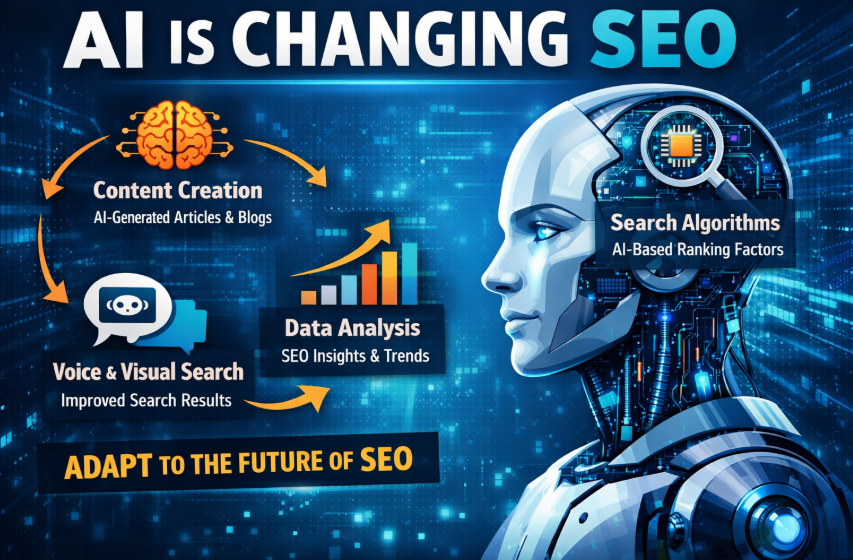
Artificial Intelligence (AI) has become a core part of how search engines work and how websites compete for visibility. SEO is no longer just about keywords and backlinks. It now depends heavily on how well content matches user intent, how useful it is, and how intelligently it is structured.
In 2026, AI is shaping almost every part of SEO, from content creation to ranking systems. Tools like machine learning models and natural language processing help search engines understand content in a more human-like way. This means websites must focus more on value and clarity instead of keyword stuffing.
Evolution of SEO from 2010 to 2026
SEO has changed massively over the last decade. Around 2010, SEO was mostly focused on exact-match keywords, basic link building, and technical optimization. Websites could rank just by repeating keywords and building a large number of backlinks.
As Google improved its algorithms (like RankBrain, BERT, and later AI-based systems), the focus shifted toward meaning and context. By 2026, SEO is deeply influenced by AI systems that evaluate content quality, user satisfaction, and engagement signals rather than just keyword density.
Today, SEO is more about understanding the user than just optimizing for search engines.
Role of AI in Search Engines
Modern search engines rely heavily on AI models to interpret queries and rank results. Instead of simply matching words, AI understands the intent behind a search. For example, when someone searches “best SEO tools for beginners,” the system knows the user wants recommendations, not just definitions.
AI also helps search engines detect spam, low-quality content, and duplicate pages more effectively. It continuously learns from user behavior, click patterns, and engagement metrics to improve ranking accuracy.
This makes SEO more dynamic and competitive than ever before.
Why AI Matters for Modern Websites
For modern websites, AI is not optional anymore; it is essential. Businesses that use AI-powered SEO strategies can analyze data faster, create optimized content, and target the right audience more effectively.
AI in Content Creation and Optimization
AI has completely changed how content is created and optimized for SEO. In 2026, many marketers use AI tools to generate topic ideas, write drafts, and improve readability. But the real value of AI is not just content generatio; ,it is optimization.
AI can analyze top-ranking pages and suggest improvements in structure, keyword placement, and readability. It helps writers create content that matches search intent more accurately. However, human input is still important to ensure originality, tone, and real value for readers.
Search engines now prioritize content that is helpful, clear, and written for users rather than algorithms.
AI-Powered Keyword Research
Keyword research has become smarter with AI. Instead of relying only on search volume and competition, AI tools now predict user behavior and search trends.
These systems can identify related keywords, long-tail variations, and even emerging topics before they become highly competitive. This gives websites a chance to rank earlier and gain traffic faster.
AI also groups keywords based on intent, making it easier to build topic clusters and content strategies that align with modern SEO practices.
User Intent and Semantic Search
One of the biggest changes in SEO is the shift from keywords to user intent. AI-powered search engines now understand what users actually want, not just what they type.
For example, a search like “how to grow website traffic” is interpreted as a need for guides, strategies, and tools, not just random articles. This is called semantic search.
Websites that clearly answer user questions and provide complete information are more likely to rank higher in 2026.
AI in On-Page SEO Optimization
On-page SEO has also become more advanced with AI assistance. From meta titles and descriptions to heading structure and internal linking, AI tools can now suggest optimal improvements.
AI Impact on Link Building Strategies
Link building has also evolved with AI. Earlier, SEO professionals manually searched for websites, sent outreach emails, and tracked backlinks. In 2026, AI helps automate much of this process.
AI tools can identify relevant websites, analyze domain authority, and suggest the best link opportunities. They can also personalize outreach messages based on the target site’s content, increasing the chances of getting backlinks.
However, quality still matters more than quantity. Search engines now evaluate the relevance and natural placement of links, not just their number.
Voice Search and AI Assistants
Voice search has grown significantly due to AI assistants like Google Assistant and Siri. People now search in a more conversational way, such as “best SEO tools for small business in 2026” instead of short keywords.
This shift forces websites to optimize for natural language queries. Content must answer questions clearly and directly to rank in voice search results.
AI also helps search engines extract quick answers from web pages, making featured snippets more important than ever.
Challenges of AI in SEO
While AI brings many advantages, it also creates new challenges. One major issue is content saturation. Since AI can generate large amounts of content quickly, the internet is becoming more crowded with similar articles.
Another challenge is maintaining originality. Many websites rely too heavily on AI-generated content, which can reduce quality if not properly edited.
Search engines are also constantly updating algorithms to filter out low-value or repetitive content, making SEO more competitive and unpredictable.
Future of SEO in the AI Era
The future of SEO will be deeply connected with AI systems. Websites that focus on user experience, high-quality content, and real value will continue to perform well.
SEO will become less about technical tricks and more about understanding human behavior. AI will handle much of the technical optimization, while humans will focus on strategy, creativity, and trust-building.
In the coming years beyond 2026, successful websites will be those that combine AI efficiency with human insight. Those who adapt early will have a strong advantage in search rankings and online visibility.